Wednesday, 20 December 2017

Litecoin founder Charlie Lee has sold all of his LTC


Charlie Lee, the former director of engineering at Coinbase, is selling almost all of his holdings in Litecoin (LTC), the cryptocurrency that he founded in 2011.
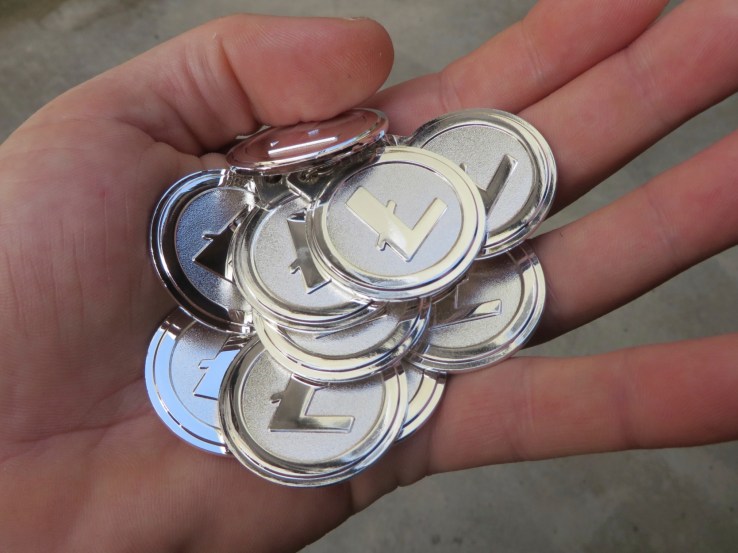
Lee explained in a post on Reddit that he is selling all of his LTC coins — bar a number of physical coins he keeps as collectibles — to avoid the conflict of interest that comes with  his influence and position as LTC founder.
Thanks to his time at Coinbase and LTC, Lee is regarded as a key influencer in the       crypto space and he has accumulated more than 378,000 followers on Twitter, where        his handle is @SatoshiLite. While he said he has stayed away from tweeting about LTC prices directly, he acknowledged his tweets have been criticized in some quarters as manipulating the price despite whatever his best interest. Lee readily admits that his  position represented a conflict of interest, hence the unload.
“Whenever I tweet about Litecoin price or even just good or bads news, I get accused of doing it for personal benefit. Some people even think I short LTC! So in a sense, it is conflict of interest for me to hold LTC and tweet about it because I have so much influence. I have always refrained from buying/selling LTC before or after my major tweets, but this is something only I know. And there will always be a doubt on whether any of my actions were to further my own personal wealth above the success of Litecoin and crypto-currency in general,” Lee wrote.
We don’t know how many LTC that Lee held, and had sold, but now he said he is      focused on developing the cryptocurrency itself.
“This is definitely a weird feeling, but also somehow refreshing. Don’t worry. I’m not       quitting Litecoin. I will still spend all my time working on Litecoin. When Litecoin                   succeeds, I will still be rewarded in lots of different ways, just not directly via ownership     of coins. I now believe this is the best way for me to continue to oversee Litecoin’s growth  ,” he added.
Note that Lee’s brother — Bobby — is the founder of China’s largest exchange BTC        China, so this is definitely a powerful crypto family.
Like Bitcoin, Ether and others, Litecoin’s value has grown explosively this year.
It is the world’s fifth larger cryptocurrency, according to Coinmarketcap.com, with a total ‘market cap’ of more than $2 billion. It’s value, at the time of writing, is $330.14 per coin,     up more than 75X from just $4.36 on January 1, 2017.
Trading volumes of the coin have also reached unprecedented levels at the tail end of  2017, as indicated in the bottom graph in the chart below.

Click-to-WhatsApp messaging buttons are now rolling out in Facebook ads


WhatsApp has always said that it has no plans to put ads into its own app, but this is        not stopping Facebook, which now owns WhatsApp, from figuring out other ways of monetizing the hugely popular messaging service, which has around 1 billion daily users.
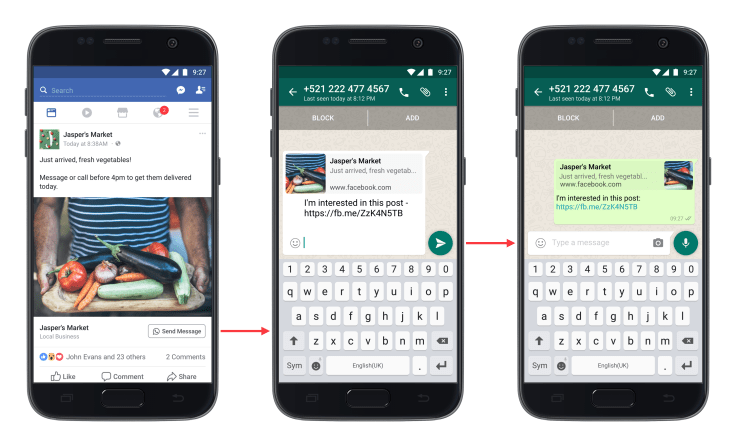
Today, Facebook is launching a new ad unit that will let businesses create a link            between the two platforms: advertisers can now include a button on their ads so that       people can call or message via WhatsApp with the click of a button.
We reported early sightings of the feature in test mode earlier this year.  Now, Facebook has confirmed to us that it’s rolling this out gradually, starting first with North and South America, Africa, Australia and most of Asia.

You might notice that Europe is not included in the list, and wonder if that might relate to news that Facebook last year had to pause efforts to share data between the two platforms when it was deemed to violate data protection laws.
From what we understand, the plan is to introduce Europe at a later date, but Facebook is going to first observe how the feature is used elsewhere, and is also still working through questions from outside the company about how WhatsApp and Facebook will work together.
(Those outside the company may well include consumers, but also regulators.)
The new feature getting announced today, more generally, follows on from some bigger developments for how WhatsApp is already being used by businesses.
Facebook tells us that more than 1 million Facebook Pages already include WhatsApp numbers in their posts each month, which implies that         there is already a pipeline between the two companies being used by businesses more informally to connect with customers more directly.
Anecdotally, I’ve heard that in some developing markets, businesses are using their WhatsApp and Facebook pages as their primary points of contact for users, so this       would make some sense to expand for Facebook, as the new White and Yellow Pages,  respectively.
“Many people already use WhatsApp to communicate with small businesses. It’s a fast, convenient way to stay in touch,” said Pancham Gajjar, product marketing manager, Facebook, in a statement. “By adding a click-to-WhatsApp button to Facebook ads, businesses can now make it even easier for people to learn about their products, set up       an appointment or use their service.”
The other trend to note here is that WhatsApp has been working on a way of creating         more specific business accounts for some time now. Most recently, it’s posted some         more information on its help pages about how business accounts will be verified,      confirmed or unconfirmed — although it has yet to roll out any specific products or         pricing tiers that       speak to these three statuses.
The new button ad-unit is also similar to the click-to-Messenger ads that Facebook previously rolled out.
“That format was the first ad product to explicitly link activity on Facebook with activity           on Messenger, and it was followed by other ad formats on Messenger itself,” said eMarketer principal analyst Debbie Williamson. “It seems that Facebook is following a similar strategy for WhatsApp, starting with click-to-WhatsApp ads on Facebook, and presumably eventually rolling out ads on WhatsApp itself.” (Which really would be a          track back from WhatsApp’s mission statement.)
For now, Facebook does not have plans to add the WhatsApp button integration to             regular consumer services, although you can see the potential for putting the links in,           say, Pages where users want to offer a contact address, or in the Marketplace next to  items that are being sold, or even in job listings.
“We recently started testing different ways for a Facebook Page to point people to their WhatsApp presence from the Page itself,” a spokesperson said, “but don’t have         any more details to share on that right now.”

Overstock’s CEO launches new trading platform and token, tZero


Few mainstream business leaders have taken to the blockchain quite like Patrick Byrne. The founder of Overstock.com has been accepting Bitcoin since 2014 and has been   talking about disrupting the payments world with transparent, low-cost, and sane blockchain-based systems. With tZero, he just started his roll toward full blockchain adoption.
TZero, at its core, is a SEC-regulated alternative trading system (ATS). Rather than depending on broker dealers to buy and sell securities, tZero works, in theory, like       money sender Transferwise by matching buyers and sellers in a dark pool. The goal is      to create an alternative to the NASDAQ with a ledger that is open, transparent, and    immutable.
“I think it’s a historic event. We’re opening a new type of capital market,” Byrne told Coindesk.
Byrne said the company was also launching a token sale to help seed the platform. The tokens, like poker chips, will be used to buy and sell on the platform and Byrne said the   pre-sale is vastly oversubscribed.
Byrne is convinced that this is the future. He is selling the Overstock retail business         and will focus primarily on tZero and a new partnership, De Soto Inc., aimed at              bringing millions around the world out of poverty by digitizing the informal ledgers           used by those outside of traditional banking and business ecosystems.
TZero is the first SEC regulated crypto ATS to see the light of day and Byrne wants to reduce the bad actors and bag actions traditionally associated with cryptocurrency in general and token sales in particular. The company will only sell initial tokens to            accredited investors or offshore buyers but they expect to offer public sales as well.

Microsoft starts testing its long-promised Windows 10 Timeline feature


When Microsoft announced the Windows 10 Fall Creators update, one of the most interesting features the company demoed was Timeline, which lets you find andresume  your recent activities as you move between PCs and iOS and Android phones. It’s    basically a global task view, backed by Microsoft’s cloud services. Likesome other         features, Timeline wasn’t quite ready in time for the Fall Creators update, though, so        it’s only today that Timeline is making its debut in the latest Windows 10 Insiderpreview       build (and only for those users who are in the more experimental Fast ring, as well as  those who opted in to the Skip Ahead builds).

Tuesday, 19 December 2017

Apple’s iMac Pro arrives December 14, starting at $4,999


It seems like forever ago that Apple first teased the iMac Pro, the souped up, professiona grade version of its all-in-one. Announced back at WWDC, the company promised the computer would arrive sometime in December, and in spite a few months of near radio silence on that front, it looks like it’s about to deliver. 
The dark gray desktop will be available in a matter of days, on December 14, bringing with
 it some pretty nutty internal specs and a price tag to match. The iMac Pro starts at $4,999 and includes up to an 18-core Xeon processor, 128GB of memory and 4TB of storage. This
 is pretty a serious piece of machinery in a form factor that was once considered a bit of an at-home computer starter kit.

Twitter Ads info and priIt’s similar to what we saw with the iPhone X launch, 

Fitbit is having a bad day


Fitbit is, once again, not having a good day after spending the year in mostly middling
status as it looks to prove there’s a market for fitness trackers as well as its own smartwatch.
The culprit today is a Wall Street firm slapping a “sell” rating on the company’s stock, which
often results in a resounding rejection of its potential going forward and sparks a sharp drop
-off in the company’s share value. Fitbit fell around 8.5 percent this morning after a year
 that tried to recover from a steep decline at the beginning of the year amid uncertainty around its business.
Here’s a look at what happened:
Fitbit’s now down more than 16 percent in the last year. Volatile companies are often vulnerable to these kinds of swings as a result of Wall Street firms rating the shares, which can range from recommendations to buy or sell the stock based on its performance or analysis of its potential business.
For Fitbit, that’s bad news, because the company needs to keep its share price up as companies can use shares as part of compensation packages when they try to hire new people. There’s also always a morale component, as the stock price is a very public-facing barometer of the company’s performance (even if people try to argue against its importance), and one that can wave off potential talent that would be interested in joining the company.
The last update we got from Fitbit was a slew of apps coming to its Ionic smartwatch, which included the addition of apps like Yelp and Uber. But as Apple continues to retool the Apple Watch with new features for health tracking, which appears to be working in a way to detect some common conditions according to a study from UCSF, it’ll face increasing competition when people look at it as a health tracker.

Fundings & Exits World Photography Japan Konica Minolta ispace just raised $90 million to launch two private moon missions by 2020


Japanese company ispace has raised $90.2 million in a Series A funding round, an amount it’s calling the “largest ever” Series A in commercial space financing. The funding comes from Innovation Network Corporation of Japan, Development Bank of Japan, Tokyo Broadcasting System, Konika Minolta and others, and will help the company continue its progress towards a very ambitious target: Launching not one, but two lunar missions within the next three years.
ispace intends to launch its first Moon mission, aptly dubbed ‘Mission 1,’ by the fourth quarter of 2019, and then to do a second by the end of 2020. The first will put its lander into orbit around the Moon for observation, and then the second will see the same lander descend to the Moon’s surface, where it will deploy mapping rovers to conduct further experimentation.
This Japanese private space venture is currently in the running for the Google Lunar XPrize for lunar missions, and anticipates that the Moon will have a population of around 1,000 permanent residents by 2040, with as many as 10,000 visitors and tourists making the lunar trip every year. Its goal is to create a transportation system that can provide regular cargo and scientific service to the moon, something that will be required for continued Moon-based (and/or Moon base) operations.
Commercializing the Moon is a logical next step after continuing to make low-Earth orbit accessible to private companies and enterprise – I think the biggest question now is whether or not the timelines here are realistic.